


French pharmacy products have a following in the US for reasons that are easy to understand: practical skincare, straightforward routines, and the appeal of discovering something useful on a pharmacy shelf in France. Search for the best French pharmacy products, and you will usually find moisturizers, cleansers, and other skincare staples. But that familiar pharmacy also has a quieter category: supplements. If you are curious about French pharmacy supplements, what should you actually look for? Here is how to think about the pharmacy model, read beyond the packaging, and understand what French pharmacy expertise means for Kaia Relief’s supplements.
What “French pharmacy” means
In France, the pharmacy is a familiar place to buy everyday health products. Skincare and supplements sit within that broader setting. You might visit for something specific, then return for products that become part of your routine.
That everyday role helps explain the trust people associate with French pharmacies. They are places connected with health, practical needs, and familiar purchases. For an American visitor, the discovery can feel different from browsing a beauty counter or scrolling through an endless online marketplace.
Still, the words “French pharmacy” deserve a closer look when you see them online. A product sold in a pharmacy, a brand associated with France, and a supplement manufactured in France describe different things. Ask which one a brand means.
The most useful question is simple: what can this company tell me about the actual product? A French connection becomes more meaningful when it comes with clear information about manufacturing, quality oversight, ingredients, and use.
The best-known French pharmacy products
For many US shoppers, French pharmacy begins with skincare. Cleansers, moisturizers, body creams, lip care, and products for sensitive skin are the categories they recognize first. These are everyday purchases, often discovered through travel guides and skincare lists.
If you are building your own list of the best French pharmacy products, start with what you need. A product that fits someone else’s bathroom shelf may have little relevance to yours. Consider its purpose, ingredients, directions, and how comfortably it fits into your existing routine.
Supplements are a quieter part of the same pharmacy landscape. They are commonly sold in French pharmacies, alongside other everyday health products. They may receive less attention in travel shopping lists, but they belong in the conversation.
Shopping for them calls for a different kind of reading. With skincare, you may begin by considering texture or the type of product you want. With a supplement, start with the ingredient list, quantities, serving information, and directions. Those details help you understand what you are choosing.
You do not need to become an ingredient expert before making a purchase. You should, however, be able to find clear answers to basic questions without searching through several pages of promotional language.
What to look for in a French pharmacy supplement
A useful supplement checklist works whether you are browsing in France or ordering from home in the US. Look for specific answers to the following questions.
1. Where is it made?
Look for an explicit manufacturing location. A French name, a Parisian photograph, or French words on a box do not answer that question.
Pay attention to the scope of the statement, too. A brand may sell several kinds of products. Check the supplement you are considering rather than assuming that everything from the same company is made in the same place.
2. Who oversees quality and batch release?
Ask what the company can explain about manufacturing oversight. Who is responsible for quality control? Who is involved in batch release, the step when a production batch is cleared for release?
Look for a description of responsibilities. A credential is useful context when the company also explains the person’s role. You should be able to understand how that expertise connects with production.
3. Can you see every ingredient and its dose?
You should be able to read what is in the supplement and how much of each ingredient the stated amount contains. Check whether quantities refer to one capsule or a serving that includes several capsules.
If a product has two formulas, look at each one separately. A daytime capsule and an evening capsule may have different ingredients and amounts. Their shared box should not make those differences harder to see.
When comparing products, compare equivalent quantities. A front-of-box number means little until you know what it measures and how it relates to the directions.
4. Are amounts hidden inside a proprietary blend?
Look for individual ingredient amounts rather than a single total for a group of ingredients. A proprietary blend name can sound specific while leaving you unable to see the quantity of each component.
Full disclosure makes comparison easier. You can read the formula on its own terms and bring the label to a conversation with your healthcare professional if you have questions.
5. How is the supplement packaged?
Check whether the packaging is sealed and how you will use it day to day. With individually sealed capsules, you can take one while leaving the others sealed.
Think about your own routine. Will you need to distinguish between two formulas? Can you identify the capsule you intend to take? Clear packaging and clear instructions should work together.
6. What manufacturing standards does the company identify?
For a supplement sold in the US, ask the brand to identify the US dietary supplement manufacturing standards it follows. Look for a specific answer rather than a general promise of high quality.
Keep the meaning of that answer in focus. A manufacturing statement tells you about how a product is produced. Read it alongside the ingredient list and directions, without turning it into a promise about your personal experience.
You can use these six questions before you buy. If an answer is missing, ask the company directly. A useful response should help you understand the product more clearly.
How Kaia Relief applies French pharmacy expertise
For Kaia Relief, French pharmacy expertise describes where and how our supplements are made.
Our supplements are manufactured in France at a site run by a doctor of pharmacy, with pharmacy expertise involved in quality control and batch release. They are produced under the US FDA dietary supplement manufacturing rules, 21 CFR Part 111, known as current Good Manufacturing Practice. Documentation is on file.
Alongside how they are made, you can see what is inside: separate formulas, individually sealed capsules, and every ingredient and dose listed. Here is what you will find in our two French-made supplements.
Cycle System: separate Day and Night formulas
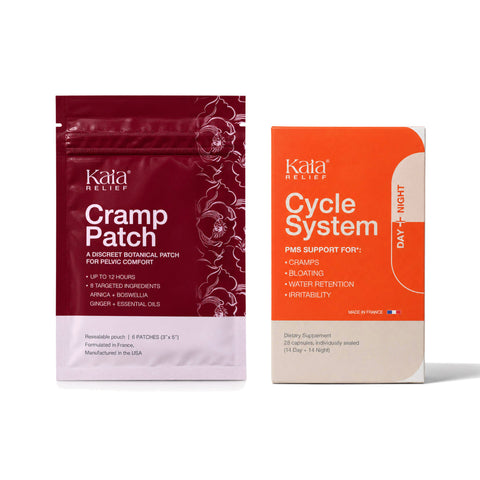
Cycle System is a PMS support supplement with two separate formulas in one box: 14 Day capsules and 14 Night capsules, each individually blister-sealed.
Each Day capsule contains fennel 100 mg, rhodiola 100 mg, turmeric 50 mg, chaste tree (vitex) 40 mg, ginger 10 mg, black pepper 5 mg, vitamin B6 5 mg, and vitamin D 2.5 mcg.
Each Night capsule contains lemon balm 80 mg, yarrow 80 mg, passionflower 50 mg, magnesium (bisglycinate) 30 mg, vitamin B6 5 mg, lavender oil 2 mg, and sweet orange oil 2 mg.
Cycle System is used for about nine days per cycle. The box directions: start 7 days before your period and continue through day 2. If your cycle is irregular, start with symptoms.
The box includes extra capsules for flexible use: if needed, the directions allow 2 Day capsules in the morning and 2 Night capsules in the evening, with a maximum of four capsules per day. That is why a nine-day routine comes in a box of 28 capsules.
Urinary Duo: botanical and probiotic capsules
Urinary Duo is a urinary tract health supplement that pairs a cranberry botanical capsule with an LR06 probiotic capsule.
Each box contains 14 Botanical capsules and 14 Probiotic capsules, individually sealed and kept separate. Each Botanical capsule provides 36 mg of cranberry PACs. Each Probiotic capsule provides 6 billion CFU of LR06. The standard daily serving is one of each capsule, so those amounts refer to that serving, not the whole box. Urinary Duo is intended for short-term use, for up to seven days.
As with Cycle System, every ingredient and dose is listed on the label. You can review those details before you buy, rather than relying on the product name to tell you what is inside.
Frequently asked questions
Are French pharmacy supplements available in the US?
Yes. You can buy French-made supplements in the US, including Kaia Relief’s Cycle System and Urinary Duo. Check the manufacturing location, full ingredient information, and directions for the specific product you are considering.
What does “made in France” mean for a supplement?
It identifies France as the manufacturing location. Look for that statement on the specific supplement, then read the brand’s information about quality oversight, ingredients, and manufacturing standards. A location alone does not answer every question about a product.
What are the best French pharmacy supplements?
Start with your needs and the product’s disclosed facts. Look for a clear manufacturing location, quality oversight, individual ingredient doses, sealed packaging, and specific manufacturing information. Those details are more useful for choosing than a French name or an attractive box.
What does French pharmacy expertise mean at Kaia Relief?
Kaia Relief’s supplements are manufactured in France at a site run by a doctor of pharmacy, with pharmacy expertise involved in quality control and batch release. They are produced under US FDA dietary supplement manufacturing rules, 21 CFR Part 111.
Does Kaia Relief list every ingredient?
Yes. Every ingredient and dose is listed on the supplement label and on our ingredients page. Cycle System’s Day and Night formulas are listed separately, so you can review each one.
Explore every ingredient and dose on Kaia Relief’s ingredients page.
These statements have not been evaluated by the Food and Drug Administration. This product is not intended to diagnose, treat, cure, or prevent any disease.
Looking for support?
*These statements have not been evaluated by the Food and Drug Administration. These products are not intended to diagnose, treat, cure, or prevent any disease. Dietary supplements. Not a substitute for a healthy diet and lifestyle. Consult your healthcare provider before use if you are pregnant, nursing, taking medication, or have a medical condition.
Where this page cites research on individual ingredients, that research is not a claim about Kaia Relief products. Individual results may vary.


